What If the Late Middle Ages Hit ‘Delete’?

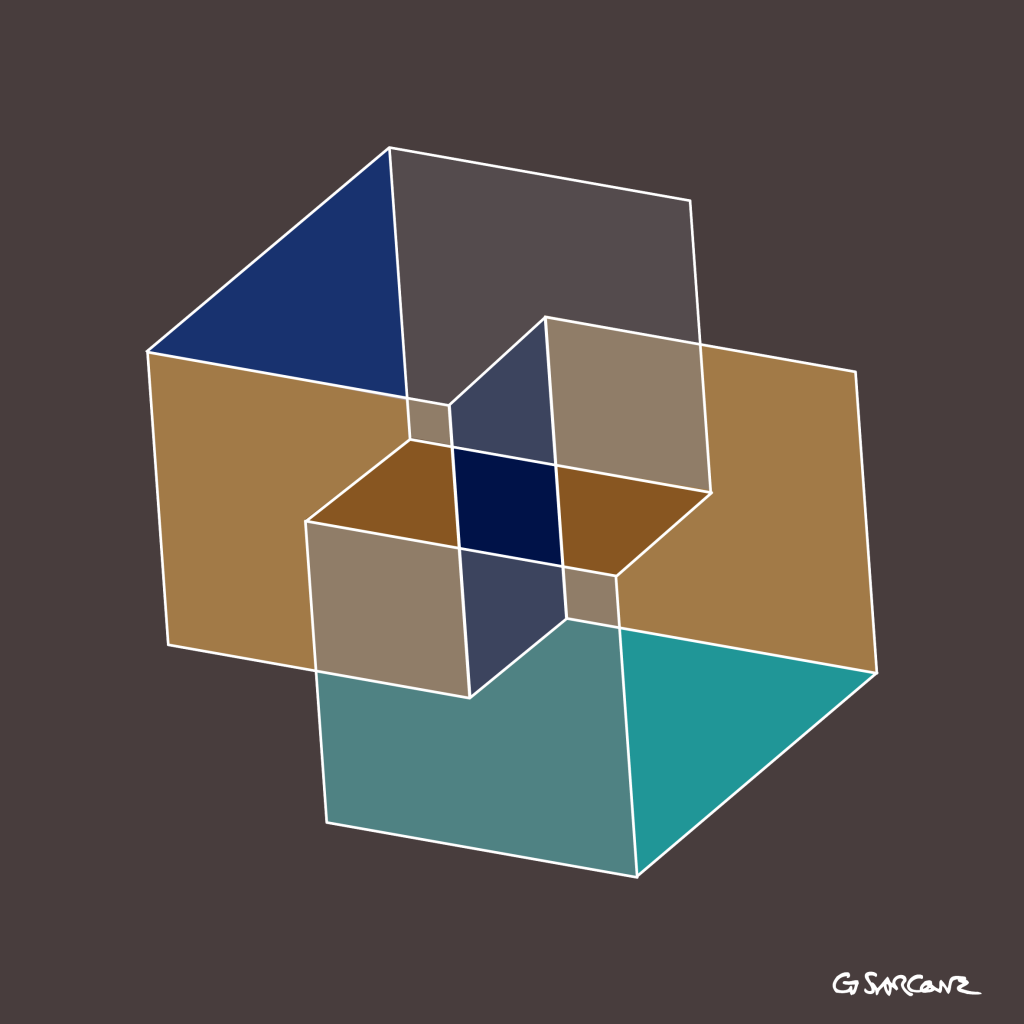
I often catch myself wondering how different our art, our literature, our techniques, our architecture, our science, and all our so-called achievements would be if, at some point in history—say, right after the late Middle Ages—everything humanity had created were wiped out so thoroughly that no one could even recall what a wheel looked like. A world where no one knew whether the Venus de Milo had been a place, a painting, a wine, a poem, or perhaps an ancient weapon. And where “democracy” or “monarchy” might just as well be fireworks or seasonal mushrooms.

As for me, I suspect that the evolution of such a world would feel strangely familiar while being completely different, a kind of cosmic déjà vu. Everything reinvented, yet uncannily the same. Worn-out ideas would return with fresh paint, old opinions would resurface disguised as revelations, eccentric religions would bloom—new in appearance, ancient in essence—and intolerance would simply find new masks. I don’t imagine this world as a better one. No, not that… just the same stage with new props, perhaps a bit more entertaining.

After all, when the dinosaurs vanished in an instant, life went on—and brought forth creatures no less terrifying. Take humans, for example.

But what do you think?

Old New World

Punctum Temporis

What is an instant—the punctum temporis—that Plato called ἐξαίφνης (exaíphnēs), the sudden? Is it a vanishing point between past and future, or the hinge on which both unfold? Plato saw it as an interruption in the flow of time, a fleeting spark where change occurs, yet which itself seems to escape duration. Augustine later reflected that the present, though indivisible, lives within us as the tension between memory and expectation.

Bergson went further, arguing that real time—la durée—cannot be reduced to a series of measurable instants. If an instant is infinitely small, it cannot be summed; if it can be summed, it is no longer an instant. Thus arises the paradox: if the present is composed of infinite instants, how can it ever be said to exist?

Perhaps time is not made of points but of relations—of movement, perception, and becoming. The instant would then be less a unit of time than a threshold of consciousness, the meeting place of continuity and change. In that sense, punctum temporis is where time reveals its true nature: elusive, dynamic, and inseparable from the act of being.

Ananke’s Die

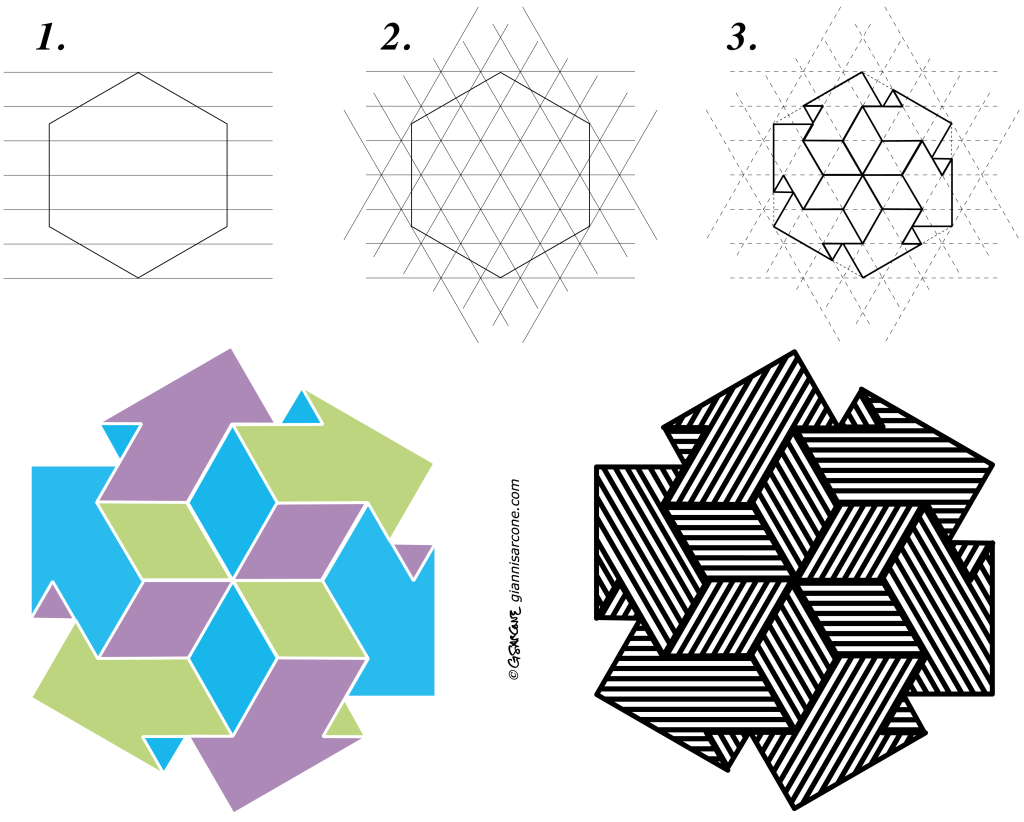
A simple study in visual perception—an exploration of how a plain hexagon can evolve into the illusion of a cube. Through precise geometry and controlled form blending, static lines awaken into rhythm and volume, giving rise to a subtle sense of depth and movement.

Constructing the Illusion

Fig. A — The Base Shape
Start with a regular hexagon. Divide it into three equal diamond shapes (rhombuses)—these represent the three visible faces of the cube. Each diamond has four equal sides: two acute angles (60°) and two obtuse angles (120°). Together, they form the geometric foundation of the cube.

Fig. B — Building Volume with Shape Blends
In Illustrator, or any other vector software, use the Blend Tool to create a shape blend inside each diamond. Start with a small central circle and blend it toward the outer edge of the diamond. Adjust the number of blend steps to control how smooth or tight the transition appears. This process builds the cube’s apparent volume and visual tension. You’ll notice that the distance from corner to corner in the nested, diamond-like shapes is slightly greater than from side to side, creating subtle gaps that lead the eye to perceive an X across the surface.

Fig. C — Perspective and Transformation
Distort slightly the hexagon to set the three diamonds in perspective. This step transforms the flat figure into a die-like cube, giving it spatial depth and presence.

ananke cube

Enhancing the Optical Effect
Next, add horizontal background lines and some color, as shown in the two examples in the image. You can also adjust the illusion by making the visible faces of the die appear slightly concave, as in the figure on the right. This effect is created by shifting the concentric, nested diamond shapes slightly off-center—the position of the central ellipse determines whether the die appears concave or convex.

 two Ananke dice

Below is the finished stage of the work. Curiously, the cube appears to hover, slide, and even emit a faint blue glow—though it remains entirely black and motionless.
Ananke’s Die is a study I began in 2010, a continuing exploration of how repetitive lines and geometric precision can trick the mind into sensing motion and color where none exist.

Ananke die

You can get Ananke’s Die as a fine art print or canvas, available in different sizes and finishes.
👉 Buy it here

Why Ananke’s Die

I titled this work Ananke’s Die after Ananke, the Greek goddess of necessity and fate.
The cube, a symbol of structure, represents order and control. Yet the three visible faces that seem to define its volume are an illusion—shifting and unstable.
Under the viewer’s gaze, the shape changes, its meaning shifts, yet the form remains.
This illusory die shows the balance between order, perception, and destiny, reminding us that what we think we control often exists within the unpredictable interplay of vision and inevitability.

This image also triggers multiple associations in a loop: hexagon, cube, die, chance, illusion, order, fate, contradiction. These connections show how perception mixes stability and randomness, revealing that what we see is shaped as much by the mind as by reality.

Immergiti nel mondo dell’arte ottica!

Le mie opere, esposte permanentemente alla Città della Scienza e al Dipartimento di Fisica dell’UNIFI, offrono un’esperienza visiva che stimola curiosità e meraviglia. Non perdere l’occasione di vederle dal vivo!
Scopri di più.

Dipartimento di Fisica dell’UNIFI

🇬🇧 Dive into the world of optical art!
My works, on permanent display at Città della Scienza and the Physics Department of UNIFI, offer a visual journey that sparks curiosity and wonder. Don’t miss the chance to experience them in person!

Learn more.

Related links:

Moona Lisa

Forbidden Brews: When Coffee, and Chocolate Stirred Trouble

In the 17th century, some of today’s most beloved drinks — coffee, tea, and chocolate — were once viewed with deep suspicion. When these “divine beverages” first arrived in Europe, civil and religious authorities saw them as exotic, even subversive. Their foreign origins and stimulating effects made them objects of fascination, controversy, and at times, prohibition.

Coffee traces its roots to the highlands of Ethiopia, where the Coffea arabica plant produces the precious beans that, once roasted and brewed, yield the dark, fragrant drink we know today. From Ethiopia, coffee spread to Yemen and across the Islamic world before reaching Europe. In 1672, an Armenian merchant named Pascal introduced the first coffee to Paris, setting up a small stand near the Saint-Germain fair — an event that marked the beginning of France’s enduring love affair with the drink.

Chocolate has an equally captivating story. It comes from the seeds of the Theobroma cacao tree, native to Central and South America. The Maya and Aztec peoples prepared it as a sacred, bitter beverage, often mixed with spices and chili — a divine elixir meant to awaken both body and spirit.

These exotic drinks, however, sparked strong reactions. Coffeehouses became lively meeting places where new ideas brewed alongside cups of steaming coffee — much to the concern of kings and clergy. Chocolate, too, stirred debate within the Church: some saw it as sinful indulgence, others as a heavenly pleasure.

Even in the Age of Enlightenment, the story continued to brew with conflict. In 1777, Frederick the Great of Prussia tried to ban coffee altogether. He feared it would replace beer — the national drink and a source of tax revenue — and even claimed that beer made his soldiers strong, while coffee made them weak. To enforce his will, he appointed “coffee sniffers” (see picture) to hunt down those secretly roasting beans.

Despite resistance and regulation, these once-suspect beverages soon became powerful symbols of refinement, curiosity, and creative thought. Today, coffee, tea, and chocolate remain faithful companions of conversation, reflection, and imagination.

"Die Kaffeeriecher" (The Coffee Sniffers). After a painting by L. Katzenstein
“Die Kaffeeriecher” (The Coffee Sniffers, 1892). After a painting by L. Katzenstein.

A Personal Reflection: Forbidden Pleasures and Creative Sparks

This history of suspicion and fascination mirrors the journey of modern art. Like coffee, tea, and chocolate, art has often been feared, censored, or condemned. Impressionists were mocked for daring brushstrokes; avant-garde movements were branded degenerate under totalitarian regimes. But prohibition, ridicule, or misunderstanding never extinguished their appeal — instead, it made them irresistible.

I see in these stories a reflection of human curiosity itself: the desire to taste, to see, to explore what lies beyond the accepted, the safe, the ordinary.

The Responsive Eye

“The Responsive Eye,” held at MoMA in 1965 and organized by William C. Seitz, was a landmark exhibition in Op Art. Featuring over 100 artists—including Bridget Riley, Victor Vasarely, Richard Anuszkiewicz, and Josef Albers—it explored how geometric patterns and color could manipulate perception.

Riley stood out with her precise, rhythmic paintings that seemed to move and breathe, challenging the way we see. The show fascinated the public, drawing huge crowds, and sparked a wave of interest in optical effects across art, design, and fashion.

Critics were divided. Some celebrated its innovation and playful engagement with vision; others dismissed it as flashy spectacle, questioning the depth and seriousness of Op Art. Personally, I see it as a pivotal moment—one that reminded everyone that perception itself could be the medium, and that art could be both cerebral and exhilarating.

Further information: https://ubu.com/film/depalma_responsive.html

Small Strokes, Big Meanings

Human writing systems are built from strokes. I’ve always been fascinated by how a simple line or mark can alter the sound or meaning of a letter, pictogram, ideogram, hieroglyph, or sinogram. Exploring scripts across the world—even from countries far apart—revealed surprising connections, almost like hidden equivalences between them. The true marvel is how our eyes can sense meaning, even when tiny, seemingly insignificant changes are made to the original sign.

In some writing systems—especially those built on characters rather than alphabets—a subtle visual change can completely shift meaning, much like how English plays with homonyms and homographs. But here, it is the visual structure itself that carries the transformation.

Take the Chinese character , meaning “person.” In Chinese and Japanese, this simple shape often acts as a base or radical. By adding a stroke, adjusting placement, or combining it with another element, you get entirely new words and concepts. A single alteration can lead to a dramatic change in meaning.

Here are a few examples showing how characters evolve from that shared visual root:

  • (dai, oo) — “big, large”
    Looks like a person with arms extended. One stroke changes the meaning from “person” to “large.”
  • (tai, futo) — “fat, thick”
    Add a small dot below , and the concept shifts from “big” to “overly big” or “thick.”
  • 犬 (ken, inu) — “dog”
    A short slanted stroke above the horizontal line of 大 turns the human figure into an animal.
  • (ten, ama) — “heaven, sky”
    By placing a stroke above the “big” shape, the idea rises upward—symbolically to the sky.
  • (shi, ya) — “arrow”
    Adding a vertical stroke that meets the upper horizontal line of turns it into a tool or weapon.
  • (ka, hi) — “fire”
    Here the strokes branch downward, evoking sparks or flames.
  • (en, honoo) — “flame”
    Double the fire element and you intensify the meaning: from fire to blazing flame.
radical transformations

What’s striking is how these changes don’t require entirely new symbols—just minimal visual tweaks. Where English relies on spelling or pronunciation shifts (like lead the metal vs. lead as in to guide), character-based languages often rely on visual logic. A dot, a stroke, or a slight rearrangement can redirect the meaning toward something bigger, higher, brighter, or more intense.

It’s a compact, elegant way to build vocabulary: meaning evolves visibly, not phonetically.

The Cube That Lies

I’ve always been drawn to the architecture of geometry. The hexagon, with its quiet strength and symmetry, sits at the root of so many spatial illusions—it’s the seed of cubes, isometric grids, and 3D paradoxes. From this shape, I began exploring structures that bend logic and perception, eventually giving life to a trio of optical works: Enigma 1, Enigma 2, and Enigma 3.

enigma 1
Enigma 1Prints & T-shirts.
enigma 2
Enigma 2Prints & T-shirts.
enigma 2
Enigma 3Prints & T-shirts.

Each piece is built around the visual tension of the impossible cube, created by merging two tribars in perfect isometric perspective. The lines suggest solidity, yet the form escapes reality—what looks structurally sound unravels the moment the eye tries to make sense of it. That’s the game I love to play: where geometry behaves, but perception rebels.

These “Enigmas” are spatial riddles dressed in stripes and angles, each one twisting the viewer’s reading of depth, volume, and continuity in its own way.

The Construction of a Stereotype: The Neapolitan Eating Spaghetti with His Hands

Images like the one below did not emerge as authentic snapshots of daily life, but as carefully staged performances. In the late 19th and early 20th centuries, a wave of photographers—from northern Europe and even northern Italy—descended upon Naples in search of the “picturesque” and the “exotic.” They were driven by the same Romantic and Orientalist impulses that had shaped the artistic imagination since the 18th century: a fascination with the “other” as a source of aesthetic and commercial consumption. To satisfy these expectations, they asked members of the working class to pose while eating spaghetti with their hands or drinking wine directly from the flask, creating scenes that conformed to a folkloric, almost theatrical narrative designed for foreign curiosity.

In reality, Neapolitans did not habitually eat spaghetti in this manner. While the very poorest—often lacking cutlery—might occasionally have done so, this was an exception rather than a rule. The subjects of these photographs were usually recruited precisely for their visibility as impoverished figures, their gestures carefully orchestrated, and their participation purchased with a few coins. Here, the camera did not document an everyday reality; it manufactured a tableau vivant, crystallizing a myth that would outlast the moment.

This visual fiction illustrates a broader sociological and philosophical pattern: the ways in which communities are reduced to caricature when mediated through the desires of outsiders. Naples, with its intricate social fabric, vibrant markets, and rich urban life, became a stage set for clichés—its complexity compressed into a singular, digestible image. In this sense, the photograph is not merely a representation but an act of authorship, shaping knowledge and perception as much as it pretends to capture it.

The legacy of these manufactured images endures. Modern media, advertising, and even social networks continue to freeze identities into simplified, performative snapshots. Stereotypes, once formed, acquire a durability that can eclipse lived experience, influencing perceptions across generations and reinforcing asymmetries of power between observer and observed.

The “spaghetti eater” is thus emblematic of a philosophical paradox inherent to photography: while the medium claims to reveal truth, it is equally capable of constructing fictions—fictions that, once disseminated, can appear more real than reality itself. In the intersection of image, expectation, and interpretation, we confront a cautionary truth: to look at a photograph is not merely to see, but to negotiate between truth, myth, and imagination.

The Neapolitan Eating Spaghetti with His Hands

The Story of Blue

Sonne au comble de l'or
l'azur du jeune hiv
er
– Paul Valéry

For me, blue is air, wind, melancholy. It is like a Fellini film—always haunted by the whisper of the wind, the scent of things, and the fleeting moments of time we wish we could hold in an eternal present. Blue can carry regret; it is, in a way, a conservative principle. Blue has always held a strange duality: so immediate, yet once so elusive. Looking back to antiquity, it fascinates me that Homer never described the sea as blue, but as ‘wine-dark.’ In Greek, kyaneos evoked a dark, mineral depth, while glaukos hovered between gray, green, and blue. The Romans spoke of caeruleus, tied to the sky (caelum), and of lividus, the bruised, bluish tone of flesh. They never elevated blue; it was the color of outsiders, the hue of Celts painted in woad. Only the Egyptians seemed to truly revere it. They invented Egyptian blue, the first artificial pigment, and made it the shade of eternity and the divine.

In the Middle Ages, blue nearly vanished from prominence. Christian art turned to red, white, and black, leaving blue to the margins. Yet the word itself was evolving. The Germanic blāo—and its Vulgar Latin adoption, blavus—once meant something far less precise: shimmering, lustrous, dark, gray, even pale or yellowish. That ambiguity makes me realize how fluid color once was, before language fixed its boundaries. From blāo we inherited English blue and French bleu. Meanwhile, through Arabic lazaward came the words azure, azzurro, and azul, all born from lapis lazuli.

Then, in the 12th century, blue was transformed. Artists began clothing the Virgin Mary in ultramarine, ground from lapis lazuli more costly than gold. What had been humble became heavenly. Heraldry embraced azure as one of its noble tinctures, and kings like Louis IX made blue their emblem. A forgotten hue became a sacred, regal presence.

By the Renaissance, ultramarine shone as a color of prestige, truth, and constancy. Painters reserved it for the highest subjects, poets linked it to loyalty, and explorers carried its name across the seas as azul. Blue had finally claimed its place.

The modern era democratized it. Prussian blue appeared in 1704, followed by cobalt, cerulean, and synthetic ultramarine. Blue poured into uniforms, flags, and revolutions; it became the shade of liberty, of nations, of collective identity. Goethe called it spiritual, a color that retreats yet draws the soul inward.

In the 20th century, painters gave blue an entirely new destiny. The Expressionists used blue to conjure emotion, depth, and inner turbulence—think of Kandinsky, who saw blue as moving ‘toward the infinite,’ or Franz Marc, who painted blue animals to symbolize spirituality and hope. Even Van Gogh’s Starry Night swirls with blue, capturing both wonder and melancholy. Later, Picasso entered his Blue Period, transmuting sorrow into tone. Yves Klein went further still, reducing blue to its purest intensity with his International Klein Blue, turning it into an immaterial field of experience. For Klein, blue was not simply a color but ‘the most abstract color of all,’ a space in which one could lose oneself.

Today, I see blue everywhere. In the jeans that became the fabric of daily life. In corporate logos designed to inspire trust. In flags that mark belonging. Blue is calm, yet melancholy; humble, yet exalted. Once overlooked, it is now the world’s favorite color.

Blue is more than a hue. It is an idea shaped across centuries—etymologically born of caelum, blāo, and blavus; symbolically stretched between heaven and earth; culturally tied to faith, power, and identity. Its story mirrors our own: restless, mutable, and ever searching for meaning.

I’ll end with a little story from my own family. After World War II, my paternal grandfather, a house painter, bought a massive surplus of blue paint from the military. He had so much of it that whenever a client asked how he planned to paint their home, his answer was always the same, year after year: “All in blue, yes, all in blue…” (in our dialect, tutt’azzurr, tutt’azzurr).

That simple phrase stuck. Before long, the whole village started calling our family the Tuttazzurr family, and I myself became known as Giuan Tuttazzurr. Blue marked our home, but also my identity and my story—etched in memory and in name.